Most Cayman businesses have a hurricane plan. The generator gets tested, the emergency contacts get updated, and somewhere there's a document listing what to do if the office floods. But almost none of those plans answer the question that matters most for operations: when the storm passes and the lights come back on — will the internet?
For Cayman businesses, that question has a specific answer. A 2024 Cayman Compass investigation found that virtually all of the islands' international Starlink secondary internet data — bank transfers, video calls, payment processing, cloud applications — travels through just two aging subsea cables. The primary system, Maya-1, is roughly 25 years old. A government-funded report described it as "the lifeblood of the economy." One fault anywhere in that chain, and every business on the same infrastructure goes down together.
Cayman's Connectivity Reality
These aren't projections — they're the present. Almost all of Cayman's international data travels through two subsea cables. Maya-1 is approximately 25 years old. The secondary link to Jamaica is in similar shape.
When those cables have a problem — and faults do happen, even if outright outages are uncommon — email stops. Cloud apps freeze. Payment terminals time out. Backups can't reach offsite repositories. Customer support calls drop. Trading platforms go silent. Your team can't VPN to the head office abroad.
It doesn't take a Category 4 to cause this. A localized fault, a ground-station issue, a power problem at a key node, a fibre cut on a feeder route — any of these can ripple through. And when they do, the businesses that stay operational are the ones with a path to the internet that doesn't depend on the same shared infrastructure as everyone else.
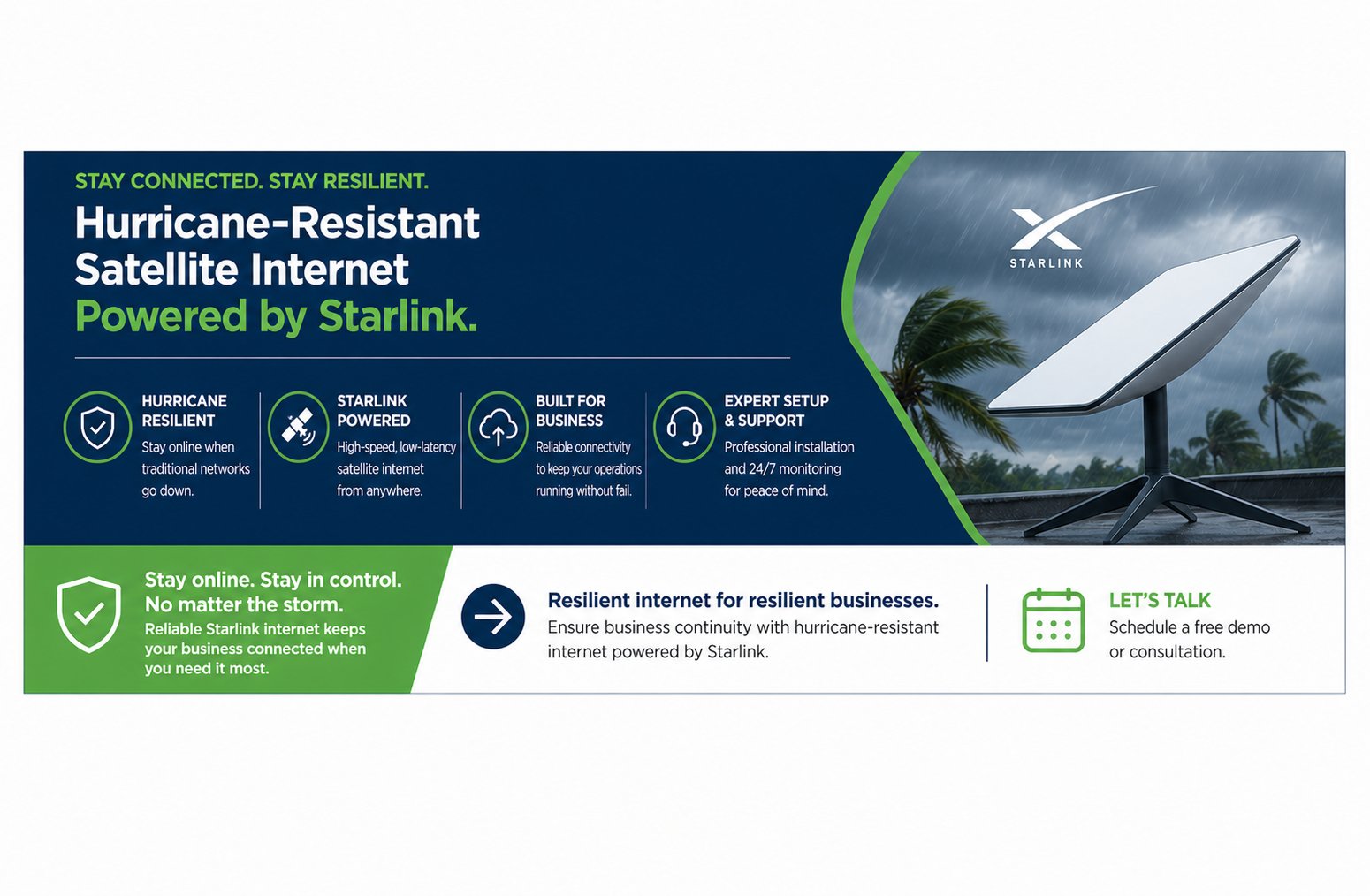
A Starlink terminal provides a fully independent internet path — bypassing Cayman's subsea cables entirely
What's Being Done — and Why It Doesn't Solve It Today
There is real progress to acknowledge. Liberty Networks has invested in upgrading Maya-1. The reconfigured Maya 1.2 system, completing in early 2026, doubles capacity and reduces latency by routing Cayman directly to the US instead of via Mexico. In February 2026, the Cayman Islands Government formally opened procurement for a new submarine cable connection to Grand Cayman. Infrastructure Minister Jay Ebanks called resilient international connectivity "essential to the Cayman Islands' economic stability, national security and everyday life."
All of this is the right direction. None of it helps if a hurricane hits this season.
Maya 1.2 improves the existing cable — it doesn't add a new one. The government's procurement process is just opening; an actual third cable in the water is years away. And even when it lands, it solves a national problem. It doesn't solve your problem if your office goes offline because of a fault that affects whichever cable you're routed on. The gap between where infrastructure is today and where it needs to be is exactly the window your business needs to close — on its own terms, right now.
The Solution: A Secondary Path That Bypasses Cayman Entirely
There is a credible, affordable, and rapidly deployable answer: a Starlink-based secondary internet connection, paired with intelligent SD-WAN orchestration that handles automatic failover.
Starlink is SpaceX's Low Earth Orbit (LEO) satellite constellation. From a business-continuity perspective, it's a category change from older satellite services. Where traditional satellite internet suffered from high latency, weather sensitivity, and slow speeds, Starlink delivers high-speed, low-latency connectivity that's genuinely fit for modern business: video calls, cloud applications, VoIP, payment processing, and SaaS platforms all work the way you'd expect.
Your business keeps its existing fixed-line connection from a local ISP — that remains your primary, day-to-day connection. A Starlink terminal on your roof provides a second internet path that doesn't touch the subsea cables. The signal goes from your dish up to satellites overhead, down to a ground station outside Cayman, and onto the global internet via a completely different route.
An SD-WAN router sits in front of both connections. It monitors performance constantly, balances traffic across both paths when everything is healthy, and switches to Starlink automatically if the primary connection degrades or drops. Most users never notice the transition — work continues. Calls don't drop. Backups complete. Payment systems stay online.
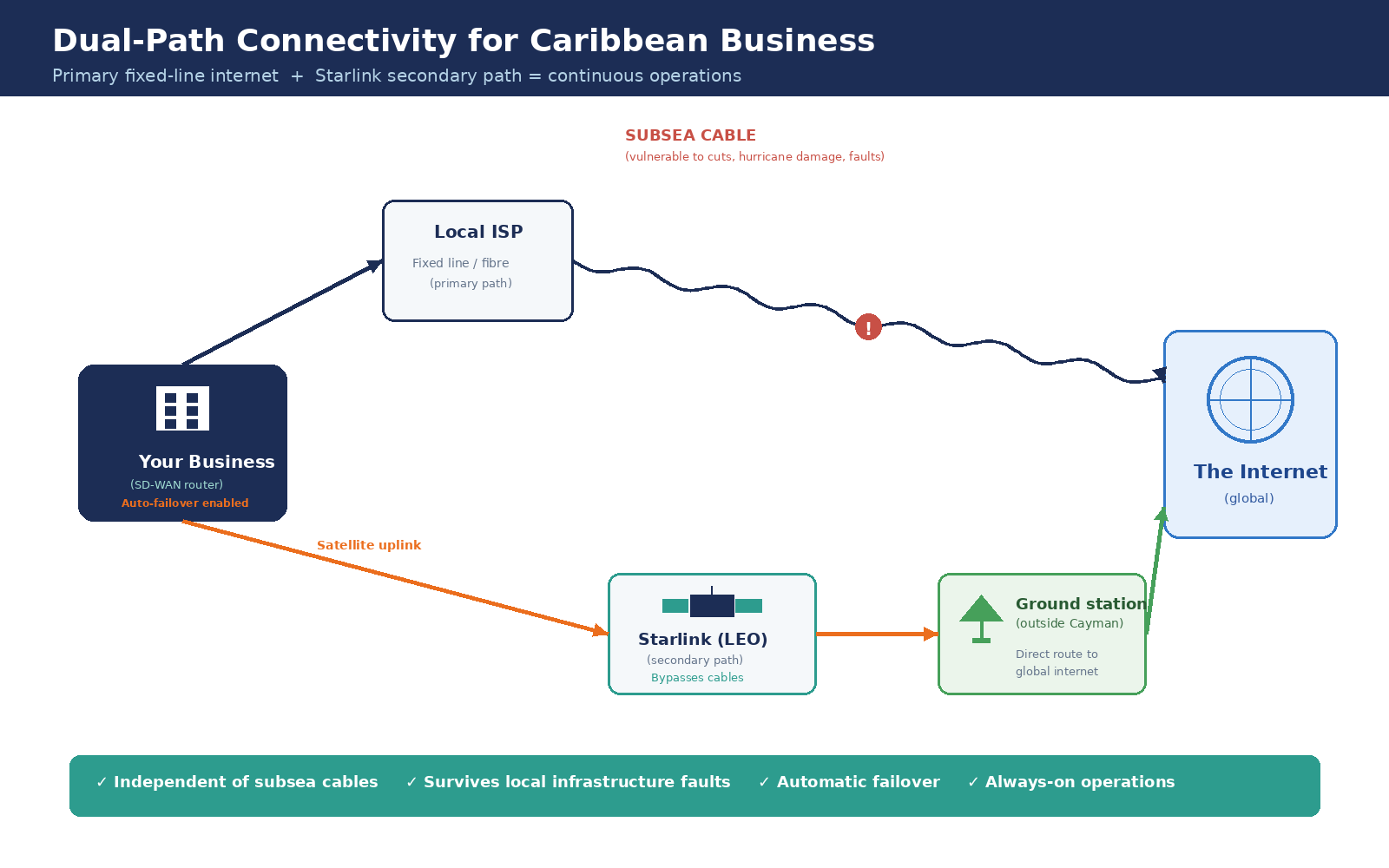
Dual-path architecture: SD-WAN routes traffic across primary ISP and Starlink, switching automatically on failure
Why Independent Infrastructure Is Non-Negotiable
Many businesses think they have redundancy because they have two internet connections. But if both connections ultimately depend on the same subsea cable — or the same local infrastructure provider — they share a single point of failure dressed up as two.
Starlink is genuinely independent. Your data leaves your roof, goes to space, and comes back down somewhere else entirely. A subsea cable fault doesn't touch it. A regional power issue at a Cayman node doesn't touch it. A hurricane that takes out a ground-level tower doesn't touch it. The only dependency is line-of-sight to the sky — which means even in storm conditions, recovery happens the moment weather clears, with no dependency on physical infrastructure being repaired first.
For businesses that cannot afford to be offline — financial services, healthcare, e-commerce, hospitality, anyone serving international clients across time zones — this is the difference between an inconvenience and an operational crisis.
A 2024 Cayman Compass investigation found virtually all of Cayman's international data travels through two aging subsea cables — a single category of failure that affects every business on the island simultaneously.
How ICT365 Delivers This
ICT365 designs, deploys, and manages Starlink-based dual-path connectivity for businesses across the Cayman Islands and wider Caribbean. The managed service includes:
- Discovery and design — assess your current setup, identify single points of failure, and quantify the business impact of an outage specific to your operation
- Hardware and installation — Starlink Business procurement, professional rooftop installation with weatherproof mounting, and configuration tuned for business-grade reliability
- SD-WAN orchestration — router configured to balance and failover intelligently across both connections, with policies tuned to your priorities
- Validation and testing — structured failover testing before go-live, simulating primary-path failure to confirm Starlink takes over cleanly
- Ongoing monitoring — continuous performance monitoring across both paths, with proactive alerting and rapid response
- Real partnership — ICT365 doesn't disappear after deployment. From hurricane-season readiness to day-to-day support, the team is here for what comes next. See the full managed IT services at https://ict365.ky/services/managed-it.
Who Needs This Before Hurricane Season
Not every organisation needs a Starlink secondary path. For some, a few hours of downtime during a regional event is uncomfortable but survivable. For others, it's untenable. If your business fits any of these descriptions, hurricane season is the wrong time to find out the hard way:
- Financial services and professional firms — international clients expect availability 24/7, regardless of what's happening locally
- Healthcare — clinical systems, telehealth, and patient records cannot go offline for hours at a time
- Hospitality and retail — payment processing, point-of-sale, online ordering, and reservations all depend on continuous connectivity
- Government and regulated entities — regulatory commitments and citizen services don't pause for infrastructure faults
- IT and MSP delivery teams — your customers' first call when local internet goes down is to you
Frequently Asked Questions
Does Starlink work during a hurricane?
Starlink requires line-of-sight to the sky. During the worst conditions of a direct hit, signal may be temporarily interrupted. The advantage is that recovery happens the moment the sky clears — with no dependency on ground-based infrastructure being repaired. For tropical storms and near-misses, Starlink typically remains operational when ground-based infrastructure does not.
What is SD-WAN and why does it matter for failover?
SD-WAN (Software-Defined Wide Area Network) is the technology that manages traffic across multiple internet connections intelligently. Without it, switching from a failed primary connection to a backup is manual and slow — staff notice, calls drop, sessions reset. With SD-WAN, failover happens in seconds and most applications continue without interruption.
Is Starlink fast enough for business use in Cayman?
Starlink Business delivers download speeds of 100–500 Mbps and upload speeds of 20–40 Mbps, with latency of 20–60ms — comparable to fixed-line broadband for most business applications. Video conferencing, VoIP, cloud platforms, VPNs, and payment systems all work reliably on Starlink.
How quickly does the failover to Starlink happen?
With ICT365's SD-WAN configuration, failover to the Starlink path typically takes under 30 seconds from the moment a primary connection fault is detected. For most applications, sessions remain active. For latency-sensitive applications like VoIP, ICT365 tunes the configuration to prioritise those workloads first.
What does a Starlink secondary internet setup cost?
Costs depend on the Starlink hardware tier, SD-WAN equipment, installation complexity, and whether ongoing monitoring is included. ICT365 provides a free connectivity assessment and produces a clear, itemised proposal before any commitment. Contact the team at https://ict365.ky/contact to get started.
Two Cables Isn't a Backup Plan — Get Your Second Path in Place
The Cayman Islands' digital infrastructure is being modernised. Maya 1.2 is a meaningful step, and a third cable is on the horizon. None of that helps the business that goes offline next month because of a fault, a storm, or a feeder-route cut. Starlink is available now, it's affordable, it deploys in days, and it works.
ICT365 will assess your current connectivity setup at no cost, identify your real exposure, and help you decide whether a Starlink-based secondary path makes sense for your business. No obligation, no pressure — just a clear picture of what would happen if the cable went down tomorrow, and what it would take to keep your business running.
---
ICT365 – Delivering IT Solutions Across the Caribbean
Not sure if your business has a genuinely independent backup path? ICT365 offers a free connectivity review — visit https://ict365.ky/contact to book yours before hurricane season.
Client name has been intentionally removed from this case study to protect confidentiality. References are available upon request.